

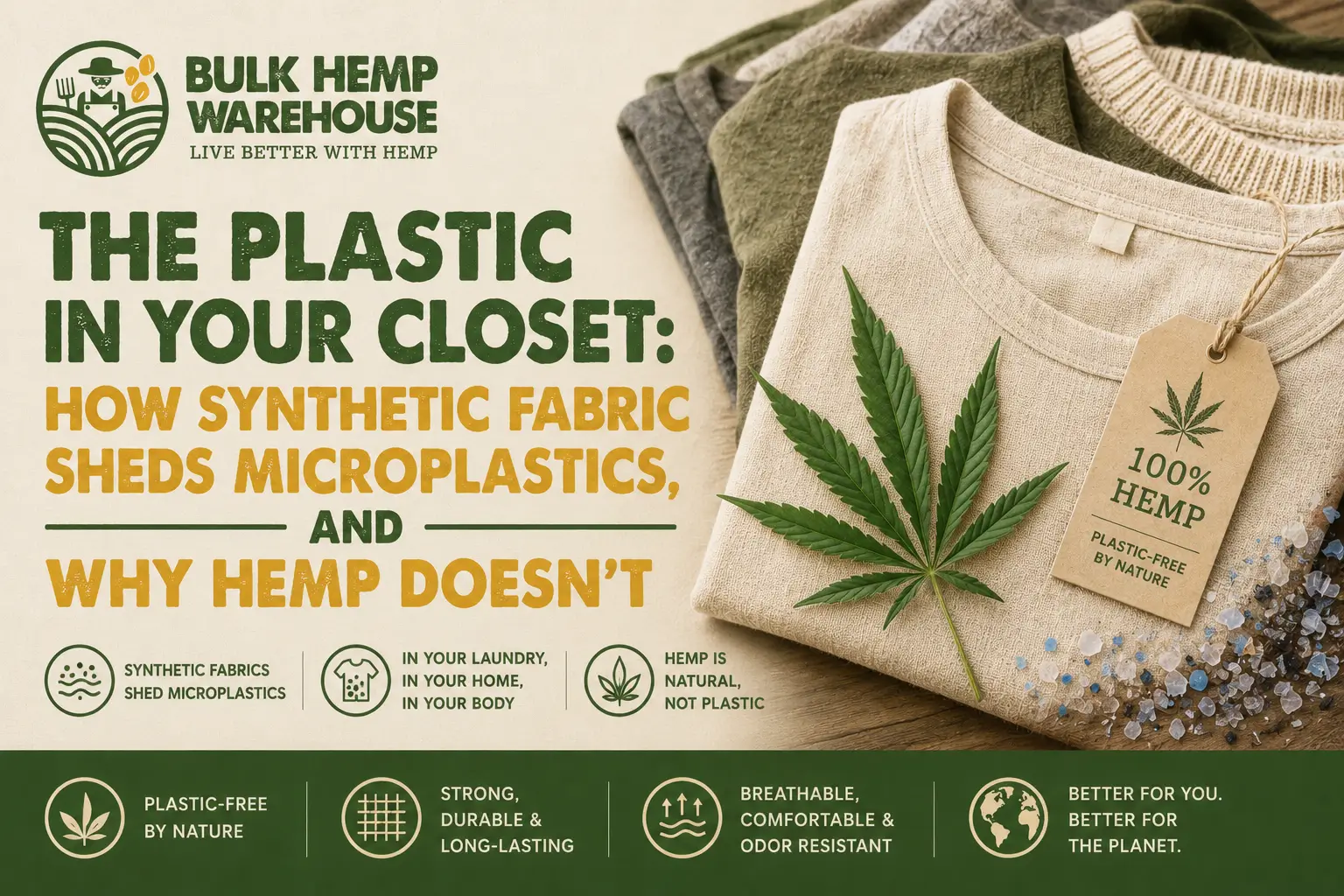
The Plastic in Your Closet: How Synthetic Fabric Sheds Microplastics, and Why Hemp Doesn’t
Page 5
- Author Tyler Hemp
- Categories: Hemp Benefits, Hemp Fabric
- Last Updated:
The Plastic in Your Closet: How Synthetic Fabric Sheds Microplastics, and Why Hemp Doesn’t

Tyler Hemp
Tyler has been supplying high quality industrial hemp seed & fiber products in bulk for projects around the world, for over 20 years. He's super passionate about hemp, and LOVE to educate on the topic.
Table of Contents
Open your closet and pull out a shirt at random. Check the tag. If it says polyester, nylon, acrylic, or “elastane,” you’re holding plastic.
Not plastic-adjacent. Not plastic-inspired. Petroleum, spun into thread, sitting against your skin for most of your waking hours.
Most of us never think about it. We pick clothes by how they look, what they cost, and whether they fit.
The fabric itself feels like an afterthought. But that fabric is quietly shedding tiny plastic fragments every time you wear it, wash it, and dry it.
Those fragments have a name now: microplastics. And they’ve turned up in places that should give anyone pause.
The good news is that the fix is refreshingly low-tech. You don’t need a gadget or a subscription.
You need different fabric. So let’s walk through what’s actually happening in your laundry, why it matters, and why we think hemp is the strongest natural fiber you can put on your body.
What’s actually in synthetic fabric
Polyester, nylon, acrylic, and spandex all start the same way: as fossil fuels.
They’re petroleum-based polymers, which is a technical way of saying they’re plastic that’s been spun into fine threads.
Polyester alone is the most common clothing fiber on the planet, and chemically it’s the same family as the PET used in disposable water bottles.
These fabrics feel soft and stretchy and dry quickly, which is exactly why they took over the apparel industry.
But softness on the rack doesn’t change what they’re made of. A fleece pullover and a single-use bottle are closer cousins than most people realize.
How your clothes shed microplastics
Synthetic garments don’t release plastic all at once. They do it gradually, across three moments in their life: when you wear them, when you wash them, and when you toss them in the dryer.
Washing is the big one. Researchers studying domestic laundry have measured anywhere from a few hundred to over 700,000 microfibers released in a single wash cycle, depending on the fabric and the load.
Those fibers are far too small for most wastewater treatment plants to catch, so they flow out to rivers and oceans.
By one widely cited estimate from the International Union for Conservation of Nature, synthetic textiles are the single largest source of primary microplastics entering the ocean, somewhere around a third of the total.
Drying adds to it.
Tumble-drying synthetics kicks fibers into the air inside your home, which is part of why microplastics show up in household dust.
And ordinary wear, the friction of a sleeve against a desk all day, releases them too.
The plastic doesn’t stay in the shirt. It goes into the water, the air, and eventually, us.
The honest part most articles skip: natural fibers shed too. Cotton, linen, wool, and hemp all lose fibers in the wash.

The difference is what those fibers are. A hemp fiber is plant cellulose. It biodegrades.

A polyester fiber is plastic, and it can persist in the environment for decades, breaking into ever-smaller pieces but never truly going away. Shedding isn't the problem. Shedding plastic is.
Why this matters for you, not just the ocean
It’s easy to file microplastics under “environmental problem, very sad, not my department.”
But the reason this topic jumped from science journals to dinner-table conversation is that the particles stopped staying outside our bodies.
Microplastics have now been documented in human blood, in lung tissue, and in placentas.
Scientists are still early in understanding what that means for health, and anyone who tells you they know the full picture is getting ahead of the evidence.
What’s clear is that the exposure is real and ongoing, and that a meaningful slice of it comes from the textiles we live in.
The clothes touching your skin all day, and the sheets you breathe against for a third of your life, are worth a second look.
The natural-fiber fix, told straight
Here’s where a lot of “sustainable fabric” guides get fuzzy, so we’ll be specific.
If your goal is to stop wearing and shedding plastic, you want fibers that grew, not fibers that were refined from oil.
Here’s how the common options actually stack up.
| Fabric | What it really is | Sheds plastic? |
|---|---|---|
| Polyester | Petroleum plastic (PET family) | Yes |
| Nylon | Petroleum plastic | Yes |
| Acrylic | Petroleum plastic | Yes |
| “Bamboo” (viscose/rayon) | Plant pulp, heavily chemically processed | No plastic, but not as clean as it sounds |
| Cotton | Natural plant fiber | No |
| Linen | Natural plant fiber (flax) | No |
| Wool | Natural animal fiber | No |
| Hemp | Natural plant fiber | No |
Notice the asterisk on bamboo.
Most “bamboo” clothing is actually rayon, where bamboo pulp gets dissolved in harsh chemicals and reconstituted into fiber.
It won’t shed plastic, but the “all-natural” halo it markets itself with is doing some heavy lifting.
We’d rather you know that than find out later.
Why hemp wins among the naturals
Cotton, linen, wool, and hemp are all genuinely plastic-free, and any of them beats polyester.
So why do we keep coming back to hemp? A few reasons that compound over the life of a garment.
It lasts, which means less total shedding
Hemp is one of the strongest natural fibers there is.
A hemp garment that survives years of washing replaces several cheap synthetic ones that would have shed plastic the whole time and then landed in a landfill. Durability isn’t just a quality flex.
Over a garment’s full life, the longest-lasting fiber sheds the least, because you’re simply buying and discarding less.
It breathes and resists odor
Hemp is naturally breathable and has antimicrobial qualities, so it tends to hold less odor than synthetics that trap heat and bacteria against your skin.
Anyone who has spent a summer day in a polyester shirt versus a hemp one knows the difference without needing a study to confirm it.
It’s gentle to grow
Hemp grows fast, needs far less water than cotton, and typically requires few or no pesticides. It even returns nutrients to the soil it’s grown in.
So the fiber that’s better for your skin happens to be easier on the land too.
It goes back to the earth
When a hemp garment finally wears out, it’s plant matter.
It biodegrades.
Compare that to a polyester shirt, which can outlast you, your kids, and your grandkids in a landfill while slowly fragmenting into the very microplastics this whole article is about.
The blend trap: read the tag twice
Here’s the catch almost nobody warns you about. A garment sold as “hemp” is very often a blend.
Hemp/cotton is fine.
But plenty of hemp activewear and underwear is blended with spandex, elastane, or polyester to add stretch, and those synthetic percentages shed plastic just like a fully synthetic garment does, only quieter.
This isn’t a reason to distrust hemp. It’s a reason to read the fabric content, not just the marketing.
Look for 100% hemp, or hemp blended only with other natural fibers like organic cotton.
If you see a synthetic in the blend, you’ve found plastic, no matter how green the label looks.
Makers who are already doing it right
We work with people building real clothing from hemp, and they’re the proof that this isn’t theoretical.
A few worth knowing:
Object Apparel, Detroit, USA
A small-batch label making clothing and underwear from GOTS-certified organic fabrics, including hemp, with natural dyes and non-toxic inks. Underwear matters more than people think here. It’s the most skin-close layer most of us own, which makes the choice of a plastic-free fiber especially worth it.
Natasha Tonic, Los Angeles, USA
A hemp swimwear pioneer making suits from certified organic hemp and cotton. Swimwear is almost always pure synthetic, so it’s a category where switching to plant fiber makes an outsized difference. Natasha’s brand says it plainly: choosing plant-based over polyester swimwear keeps microfiber out of the ocean. That’s our whole thesis, lived out in a product.
Herbert Victoria, San Francisco apparel designer
An apparel designer who built a collection with hemp as the lead textile in every ensemble, partly because, as a plant fiber, it’s biodegradable and recyclable. He shared his story with us a while back, and his reasoning maps cleanly onto everything above: he wanted a fabric that didn’t come from oil and didn’t leave a mess behind.
What 15 years and one very hemp wardrobe taught me
I’ll close with the part I can speak to directly.
As one of the owners of Bulk Hemp Warehouse, I’ve spent more than a decade around this fiber, and at this point more than 90% of my own wardrobe is hemp.
I didn’t switch over for a science paper. I switched because it feels better.
Hemp sits differently on my skin than synthetics do.
It breathes in a way polyester never has for me, it holds far less odor at the end of a long day, and it’s softened with every wash instead of pilling and going stiff.
Once you’ve lived in it for a while, putting on a slick synthetic shirt feels a little like wrapping yourself in a grocery bag.
That’s one person’s experience, not a clinical trial, and I’ll keep it in its lane.
But it lines up with everything the fiber science says, and it’s the reason I keep doing this work.
You don’t have to overhaul your closet this weekend. Start with the pieces closest to your skin, the ones you wear most, and go from there.
Ready to live better with hemp?
Whether you’re sewing your own plastic-free wardrobe or sourcing fabric by the bolt for a brand, we’ve got the raw materials and the finished pieces to help you start. Real hemp, straight from the source.
Join the makers and families already living better with hemp.
Shop Hemp Fabric Shop Hemp ClothingFrequently asked questions
Does hemp fabric shed microplastics?
It doesn’t. Hemp is a natural plant fiber made of cellulose, not plastic. Hemp garments can release tiny fibers in the wash like any fabric, but those fibers are biodegradable plant matter, not the persistent petroleum-based microplastics shed by polyester, nylon, and acrylic.
Which fabrics shed the most microplastics?
The synthetic fabrics made from petroleum are the worst offenders: polyester, nylon, acrylic, and spandex or elastane. Loosely knit synthetics like fleece tend to shed more than tightly woven ones, but all of them release plastic microfibers when worn, washed, and dried.
Is bamboo fabric a plastic-free choice?
It usually is, though the label oversells it. Most bamboo clothing is actually rayon or viscose, where bamboo pulp is dissolved in harsh chemicals and reconstituted into fiber. It won’t shed plastic microfibers, but it’s far more processed than its natural marketing suggests. Hemp, linen, and organic cotton are more straightforwardly plastic-free.
Is hemp clothing always 100% plastic-free?
Not in every case. Many garments labeled hemp are blended with spandex, elastane, or polyester for stretch, and those synthetic portions shed plastic. Always read the fabric content. Look for 100% hemp, or hemp blended only with natural fibers like organic cotton.
How can I reduce microplastics from my clothes right now?
The permanent fix is choosing natural fibers, starting with the pieces closest to your skin. Until you’ve made that switch, you can wash synthetics in cold water on shorter cycles, air-dry instead of tumble-drying, and use a microfiber-catching laundry bag or filter to cut how much plastic you release.
Why is hemp better than other natural fibers for this?
Every natural fiber beats synthetics, and hemp stands out among them for durability, since it lasts longer so you replace and discard less. It also offers breathability, natural odor resistance, low-water and low-pesticide growth, and full biodegradability at the end of its life.
International Union for Conservation of Nature (IUCN) — estimates on synthetic textiles as a primary source of ocean microplastics.
Peer-reviewed research on domestic laundry and microfiber shedding from consumer apparel (per-wash fiber-release measurements).
Environmental Working Group (EWG) and Fibershed — consumer and textile-sector guidance on microfiber shedding and natural fibers.
First-hand experience: Bulk Hemp Warehouse, raw hemp material sourcing since 2012.


OTHER EDUCATIONAL HEMP POSTS




Explore Other Posts by Bulk Hemp Warehouse